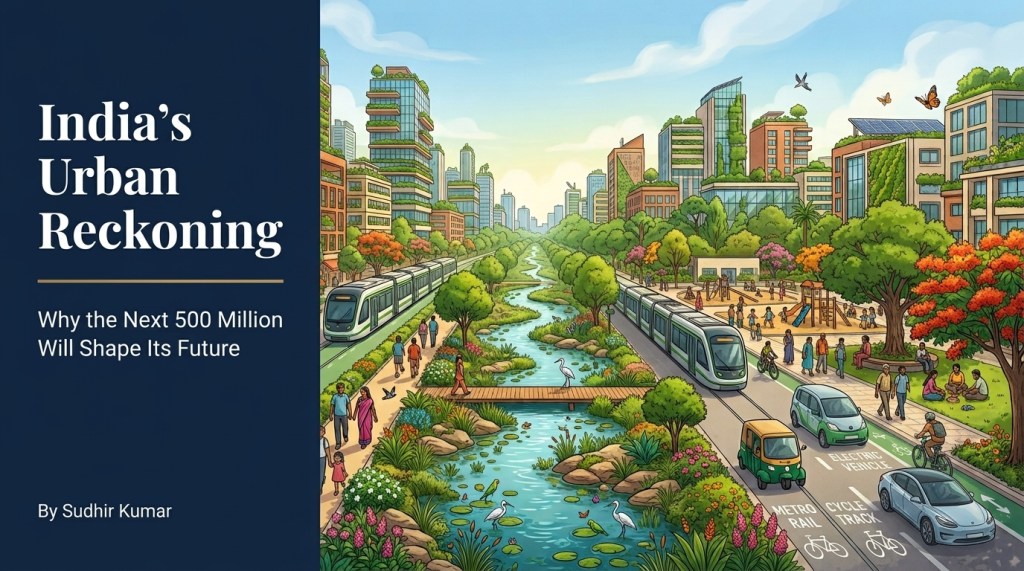
India stands on the brink of the largest urban transformation in its history. By 2050, nearly half a billion additional people could be living in Indian cities. This article explores how urbanization, AI, governance, housing, and ecological resilience could shape India’s next generation of cities.
1. India’s Biggest Urban Wave Hasn’t Even Arrived Yet
A warning for every resident of Delhi, Mumbai, Bengaluru, and every other Indian city: the biggest wave of urbanization in India’s history is still ahead of us.
By 2036, about 600 million Indians—roughly 40% of the country’s population—are projected to live in urban areas, up from about 31% in 2011. That is an urban population far larger than the entire population of the United States today.
And that is only the next milestone. The World Bank projects that India’s urban population could reach 951 million by 2050, almost doubling from around 480 million in 2020. That is roughly 470 million more people—nearly half a billion—living in Indian cities by 2050. By the World Bank’s estimate, more than half of the infrastructure, buildings, and services India’s cities will need by 2050 has yet to be built.
Think about what that means. Within a single generation, hundreds of millions more Indians will be living, working, studying, commuting, and raising families in urban India.
The question is not whether India will urbanize. It will. The question is whether we will simply allow that growth to press harder and harder against the physical and institutional limits of yesterday’s cities or whether we will use this moment to design something better.
And there is another transformation happening at almost exactly the same time. Artificial intelligence is beginning to change the nature of work itself. Where people work, how often they commute, what offices are needed for, which skills are valuable, and how businesses organize themselves could all change significantly over the coming decades. The International Labour Organization estimates that roughly one in four workers globally are in occupations with some exposure to generative AI, while emphasizing that transformation of jobs is more likely than wholesale replacement.
Put these two forces together—mass urbanization and AI-driven changes in work—and India faces something much bigger than a housing or infrastructure challenge. It faces a once-in-a-generation opportunity to rethink the city itself.
2. You Can’t Rebuild a City as Easily as You Can Build One
Existing cities will remain essential. Delhi, Mumbai, Bengaluru, Hyderabad, Chennai, Kolkata, and dozens of other urban centers are not going anywhere.
But there is a fundamental difference between building a city and rebuilding one while millions of people already live there. A new city can, at least in principle, reserve land for metro lines, cycling networks, pedestrian pathways, arterial roads, schools, parks, utilities, and housing before surrounding development makes those choices difficult.
Retrofitting an established city is far harder. Land has to be acquired. Utilities have to be relocated. Roads have to be redesigned while traffic continues to move. Businesses and residents may be disrupted. Multiple agencies and jurisdictions have to coordinate. Every improvement competes with something that already exists.
The constraint runs deeper than physical space. India’s Economic Survey 2025–26 (Chapter 15, para 15.14) points directly to a core structural bottleneck: unlike global cities operating with significant administrative and fiscal autonomy, Indian cities remain embedded within multi-layered governance structures. Urban functions are fragmented across Urban Local Bodies (ULBs), Development Authorities, state line departments, and parastatal agencies. Getting anything done in a legacy Indian city means navigating all of them.
None of this means old cities cannot change. They can and must. But the economics and logistics are different. It is generally easier to design a good city before the mistakes become physical than to correct them after concrete, property values, and millions of daily journeys have locked them in.
That distinction matters enormously when so much of India’s urban future has yet to be built.
3. What If India Built the City Before the Traffic?
This is where greenfield development becomes interesting.
A greenfield city is not automatically a smart city. It can still be badly planned, economically weak, car-dependent, or unable to attract people and businesses. A master plan does not create an economy.
But where the economic logic is sound and execution is disciplined, a greenfield city offers something that an old city rarely can: the opportunity to design multiple systems together from the beginning.
- Transport can be planned alongside housing.
- Employment centers can be planned alongside neighborhoods.
- Schools, hospitals, parks, retail, recreation, and public spaces can be integrated rather than added later.
- Water, power, sewage, waste management, and telecommunications can be designed as an interconnected system rather than repeatedly excavated and relocated.
And perhaps most importantly, the relationship between where people live and where they work can be considered before long commutes become an unavoidable part of daily life.
The goal should not be to build another collection of towers and wide roads. It should be to build a functioning urban ecosystem.
4. India Is Already Building Six Very Different Kinds of Cities
India is not starting from zero.
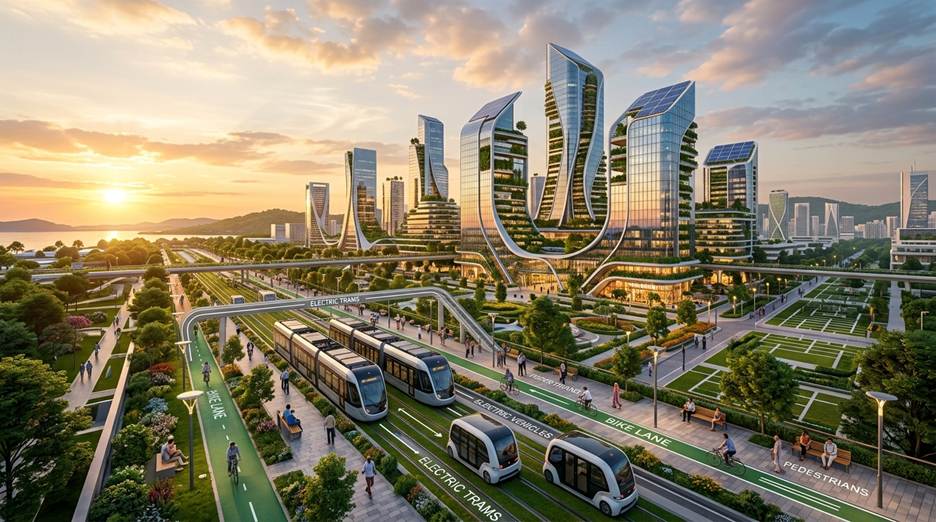
GIFT City in Gujarat offers one example of what becomes possible when infrastructure is conceived as an integrated system. Its utility tunnel houses power, raw and treated water, district-cooling pipes, ICT cables, automated waste collection and other essential services, reducing the need to repeatedly excavate developed roads for maintenance and upgrades. The World Bank has documented the tunnel as an example of integrated utility infrastructure in a greenfield urban development.
Beyond GIFT City, India’s emerging urban centers illustrate distinctly different models:
- Global City Gurugram is being developed as a large mixed-use urban district, combining workplaces, residential development, retail, social infrastructure and public spaces around an integrated planning concept.
- Reliance MET City in Jhajjar represents another model: an industrial and logistics-led urban development in which residential and commercial uses are planned around an economic core.
- AURIC, the Aurangabad Industrial City on the Delhi-Mumbai Industrial Corridor, represents a greenfield industrial-township model, combining manufacturing with residential, commercial, institutional and social uses.
- Amaravati represents a different proposition again: a planned capital city designed around a government and administrative core, with broader urban development planned around it.
- Dholera SIR represents another scale altogether: a large planned industrial region intended to support manufacturing and infrastructure-intensive economic activity, including emerging high-technology industries.
And the distinction matters. Dholera SIR should not be confused with Dholavira, the ancient Harappan city in Gujarat. The names are coincidentally similar, but the two represent urban experiments separated by roughly four millennia.
Six cities, six different approaches to the question of what makes a city work. But there is an important distinction: a city is not successful simply because its roads are wide, its buildings are modern, or its infrastructure is technologically sophisticated. A city succeeds when people choose to live there, work there, invest there, raise families there, and build communities there.
Which raises the harder question: Who, exactly, can afford to live there?
5. A City Cannot Work If the People Who Run It Cannot Afford to Live There
A greenfield city cannot simply be a master-planned haven for high-earning knowledge workers. For it to actually function, the retail clerk, the schoolteacher, the transit operator, and the factory worker all need to live within reasonable reach of their jobs. A hub that fails on affordability doesn’t become a city; it becomes a sterile real-estate asset with a skeleton staff.
In legacy cities, high land costs and fragmented governance often push affordable housing toward the unplanned margins—informal settlements that grow precisely because the formal system never made enough room for them. Greenfield cities have no such excuse. They can build affordability into the plan itself:
- Inclusion Must Be Designed Into the City: A meaningful share of new residential development should be reserved or incentivized for Economically Weaker Sections (EWS) and Low-Income Groups (LIG), with units integrated into mainstream neighborhoods rather than isolated enclaves. Reserving a meaningful share of new homes for these groups is a familiar idea in Indian housing policy; greenfield cities could go further where local economics permit, using tools such as additional development rights, density bonuses, or concessional infrastructure charges.
- Capital Must Support the Supply of Housing: Construction finance is expensive, and developers naturally tend toward the higher end of the market when land and financing costs are high. Tax concessions (such as the 1% GST rate for affordable housing) and targeted financing mechanisms like the SWAMIH Fund—which helped complete more than 58,000 stalled homes nationally by December 2025—demonstrate what targeted capital can achieve.
- Deeper Housing Finance & Rental Integration: PMAY-U 2.0 provides interest subsidies to eligible EWS, LIG, and MIG households. However, lasting affordability requires a deeper, more liquid secondary mortgage market to securitize loan portfolios and lower long-term borrowing costs. Crucially, Affordable Rental Housing Complexes (ARHCs) must be integrated near industrial corridors and employment centers from day one. The service workers who build and run the city need safe, formal, affordable rental housing long before they can buy a home.
A city cannot be truly successful if the people who make it function cannot afford to live in it.
6. Gurugram and Noida Were Not Accidents—But They Reveal the Hard Part
The story of Gurugram and Noida is often described simply as unplanned urban spillover from Delhi. That is incomplete.
India understood the need for regional urban planning decades ago. The National Capital Region Planning Board was created in 1985, and its regional plans deliberately identified key surrounding districts across Haryana (such as Gurugram, Faridabad, Sonepat, Rohtak, and Panipat), Uttar Pradesh (such as Gautam Buddh Nagar (Noida-GreaterNoida), Ghaziabad, Meerut, and Bulandshahr), and Rajasthan (Alwar and Bharatpur) as part of a broader strategy for regional decentralization.
The underlying idea was sound: growth should not be concentrated indefinitely in one core city. The harder part was implementation. Transport, housing, land use, infrastructure, and governance frequently struggled to keep pace with the speed and scale of development across multiple competing jurisdictions.
The lesson is critical: India already understood the concept of regional urban planning. The enduring challenge is executing it at the scale, speed, and cross-jurisdictional alignment that modern urbanization demands.
7. A Master Plan Can Draw a City. It Cannot Create One.
There is an equally important caution: a new city’s master plan does not manufacture people, businesses, or an economy.
Examples around the world show that it is possible to build sophisticated districts faster than demand develops:
- Songdo in South Korea demonstrated the difficulty of creating a highly planned, technologically advanced urban district at enormous scale before market demand matured.
- Masdar City in Abu Dhabi showed that ambitious sustainability and technology goals do not automatically translate into a city populated at the scale originally envisioned.
- Sejong in South Korea followed a different path, using government ministry relocation to seed an administrative center.
- Xiong’an New Area in China has similarly depended heavily on state-directed relocation of institutions from Beijing.
The lesson is not that greenfield cities fail. It is that physical infrastructure is only one layer of a city. A successful city needs jobs, businesses, universities, culture, schools, healthcare, families, social networks, and a reason for people to stay. You can build physical structures; you cannot manufacture an urban ecosystem overnight.
8. What If Your Neighborhood Became Your New Downtown?
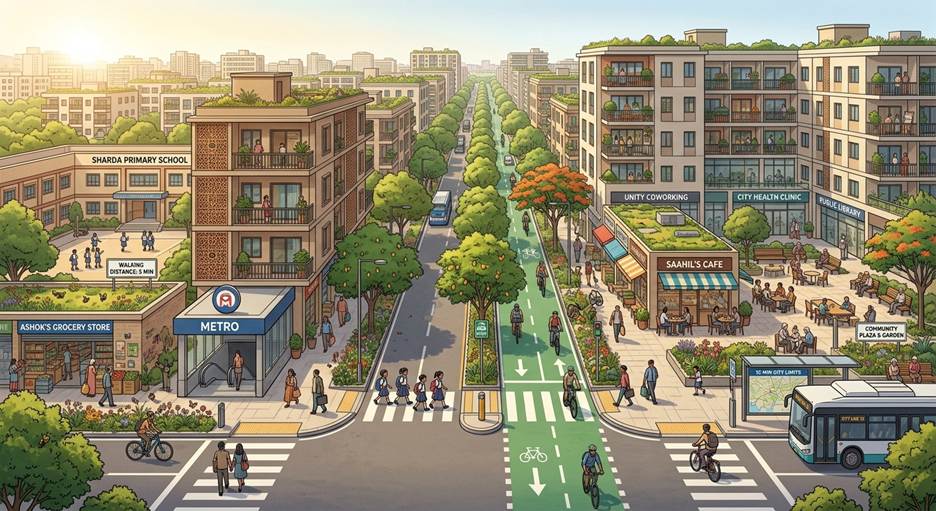
This brings us to another idea that deserves attention: the 15-minute city.
The basic principle is straightforward: a resident should be able to reach many everyday needs—schools, shops, parks, healthcare, recreation, and ideally employment—within a short walk or bicycle ride. It does not mean eliminating cars; it means reducing the necessity of using one for everything.
Now add AI and the changing nature of work. If more knowledge workers operate on remote or hybrid schedules, if smaller businesses can collaborate across geographic boundaries, and if organizations need fewer employees physically present every day, the traditional concentration of millions of workers into a few giant central business districts may become less necessary.
Offices will not disappear, nor will the value of human proximity. But the economics of proximity may change. The neighborhood itself could become a more complete economic and social ecosystem. AI may reduce the need for some commuting; good urban design can reduce the need for the commuting that remains.
9. AI May Change the Geography of Work—and the Cities Around It
The AI revolution also changes what cities may need to physically support. Data centers, semiconductor fabs, advanced manufacturing, high-reliability electricity grids, water treatment, telecommunications, and logistics infrastructure could become increasingly strategic assets.
At the same time, highly digitized businesses may require smaller, more specialized physical office footprints.
- Some jobs may become more geographically distributed across secondary hubs.
- High-speed broadband connectivity may become as important to economic geography as highways once were.
Building tomorrow’s cities around yesterday’s rigid assumptions about central office commuting would be a fundamental design mistake.
10. Where Should India Put Its Next Million People?
India’s urban future is not only about Delhi, Mumbai, Bengaluru, and Hyderabad. Regional and secondary cities will matter enormously.
The central planning question must shift from:
“How do we accommodate another million people in an already stressed city?”
to:
“Where should the next million people live and what kind of city should we build for them?”
This does not mean abandoning existing cities. It means recognizing that India has a choice about where future urban growth occurs. New urban centers can be linked to industrial corridors, logistics hubs, universities, ports, airports, and emerging economic clusters. If jobs and housing are planned together, the city grows around an economic engine rather than hoping an economy will somehow materialize after the concrete sets.
11. A Smart City Is Still a Failure If It Builds Bad Lives
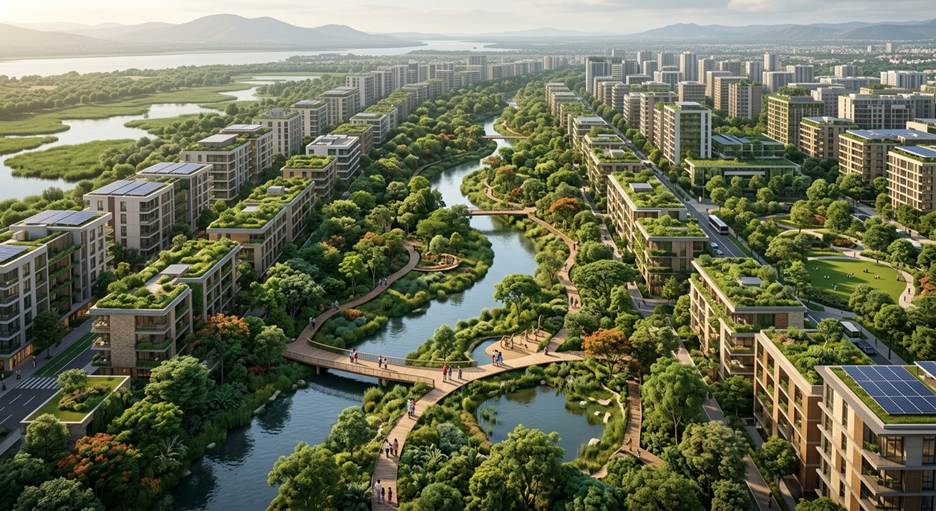
There is one principle that belongs above almost everything else: do not build smart cities that forget to build good lives or that isolate themselves from nature.
Many conventional master plans treat green space as isolated decorative parks—manicured lawns tucked between concrete blocks. But true ecological resilience requires connected natural habitats.
For wild biodiversity, pollinators, native plants, soil organisms, and micro-flora to survive, cities must preserve and connect natural habitats:
- Interconnected urban forests, wetlands, waterways, grasslands, and riparian corridors allow living ecosystems to function across the urban landscape rather than leaving nature stranded in isolated pockets.
- Practical infrastructure benefits include natural flood management, urban heat island mitigation, stormwater absorption, cleaner air, and direct access to nature.
A greenfield city has a rare opportunity to plan this connectivity before development fragments the landscape: map existing forests, wetlands, streams, floodplains, and habitats first, then design roads, neighborhoods, and infrastructure around them.
A city can have sensors everywhere and still be environmentally dead. The ultimate measure of a city is how well it nurtures the daily lives of its people and the living systems on which those lives depend:
- Does it give people back their time?
- Are its green spaces connected corridors for nature, or just isolated patches of turf?
- Can children walk safely to school?
- Can older people reach a park that connects to a broader network of natural spaces?
- Can the city’s rivers, wetlands, and forests continue to function as living ecosystems?
Nature is not decoration around the city. Nature is part of the city.
12. India Cannot Retrofit Its Way Into the Future
The choice is not between old cities and new cities. India needs both.
Existing cities will remain the country’s economic engines, and most urban Indians will continue to live in or around established metropolitan areas. They urgently need investment in public transportation, water and sewage systems, drainage, housing, green space, pedestrian infrastructure, and modernized urban governance. Retrofitting is unavoidable.
Governance is the missing piece in both strategies. If the Economic Survey’s diagnosis is right, the fix is not another agency but fewer, stronger ones: a single accountable city or metropolitan authority with real control over land use, transport, and utilities, led by an empowered mayor, and with the fiscal means to fund what it plans. Old cities will have to be reformed toward this. New cities can be built on it from day one, instead of inheriting decades of fragmentation.
New York, for example, has shown how mature cities can reclaim space through pedestrian plazas, cycling infrastructure, and projects like the High Line. But those projects also demonstrate the challenge: every square meter in a built-up city already has competing uses and entrenched stakeholders.
India must pursue two strategies at once: retrofit yesterday’s cities to work better, while building tomorrow’s cities differently.
13. India Has a Once-in-a-Generation Window—But It Won’t Stay Open Forever
India still holds an extraordinary structural opportunity because so much of its future urban landscape is unbuilt.
The World Bank estimated in 2022 that India would need roughly $840 billion in urban infrastructure investment over 15 years. More recent World Bank analysis points to an even larger long-term figure: India may need around $2.4 trillion in resilient, green urban infrastructure and services by 2050.
These numbers are staggering, but they reveal the magnitude of the opportunity. India is urbanizing at a moment when artificial intelligence, digital infrastructure, construction technology, renewable energy, and ecological science are advancing rapidly.
India has time to make different choices—but not time to postpone making them.
14. India Has Built Great Cities Before. Why Not Build the Next Generation?
The question was never whether India will urbanize. It will. The real question is whether India will simply inherit the flawed, car-centric urban models of the 20th century, or have the ambition to design the cities of the future.
For decades, developing nations looked to Western Europe or North America as default benchmarks. But India does not need to treat foreign templates as its primary reference.
More than 4,000 years ago, the urban settlements of the Indus Valley civilization—from the elaborate brick-built drainage of Mohenjo-daro to the sophisticated reservoirs and drainage systems of Dholavira—demonstrated remarkably advanced urban planning for their time. Planning functional, resilient settlements is not a novel foreign concept; it is part of the subcontinent’s long urban heritage.
Just as India leapfrogged landlines to become a mobile-first nation and bypassed parts of legacy financial infrastructure to build one of the world’s largest digital payments ecosystems through UPI, it has an opportunity to leapfrog in urban design as well.
The goal is not to copy the cities Europe or America designed fifty years ago. The goal is to build the high-density, human-centered, tech-enabled, and ecologically resilient cities the world will need fifty years from now.
Imagine an India where:
- A child walks safely to school.
- A parent walks or cycles to work or works seamlessly from home.
- A neighborhood integrates parks, schools, grocery stores, cafes, clinics, and community spaces within a 15-minute radius.
- Technology quietly simplifies daily life instead of adding friction.
- Connected natural corridors allow forests, wetlands, and wildlife to thrive alongside human communities.
India has traditionally looked outward for models of what a modern city should be. Learning from the world is valuable, but the ambition should go one step further.
If India gets this right, the goal should not merely be to catch up with the cities it once admired. The goal should be to build cities that the rest of the world will one day look to for inspiration.
India does not have to inherit the future. It can help design it.
Sources and References
- UNESCO World Heritage Centre, ‘Archaeological Ruins at Moenjodaro’ (Ref. No. 138) and ‘Dholavira: a Harappan City’ (Ref. No. 1645).
https://whc.unesco.org/en/list/138
https://whc.unesco.org/en/list/1645
- World Bank Group, TOWARDS RESILIENT AND PROSPEROUS CITIES IN INDIA ‘ (2025) and Financing India’s Urban Infrastructure Needs: Constraints to Commercial Financing and Prospects for Policy Action’ (2022).
https://openknowledge.worldbank.org/entities/publication/ec49d47d-1f14-50c6-beb2-1dec26bda295
- Ministry of Finance, Government of India, Economic Survey 2025-26, Chapter 15 (Urban Development & Governance Frameworks), Paragraph 15.14.
- International Labour Organization (ILO), Generative AI and Jobs: A Refined Global Index of Occupational Exposure.
https://www.ilo.org/publications/generative-ai-and-jobs-refined-global-index-occupational-exposure
- Ministry of Housing and Urban Affairs (MoHUA), Government of India, PMAY-U 2.0 and Affordable Rental Housing Complexes (ARHCs) Guidelines.
https://www.indiafilings.com/learn/gst-on-affordable-housing
https://www.pib.gov.in/PressReleasePage.aspx?PRID=2239597®=3&lang=1
- National Capital Region Planning Board (NCRPB), Regional Plan 2021/2041 Frameworks for Decentralized Urban Growth.
https://ncrpb.nic.in/ncrconstituent.html
- GIFT City Development Authority, Haryana State Industrial and Infrastructure Development Corporation (Global City Gurugram), Model Economic Township Ltd (Reliance MET City), AURIC, APCRDA (Amaravati), and DSIRDA (Dholera SIR).
https://crda.ap.gov.in/apcrdav2/views/home.aspx
About the Author
Sudhir Kumar is a former Indian diplomat, former Indian Economic Service (IES) officer, and financial professional. Educated at SRCC, JNU, FMS Delhi, and Johns Hopkins University, he writes on economics, public policy, history, urbanization, technology, and long-term development. He is currently working on a book, From the Silk Road to the Ganges: Islam’s Spread Through the Decline of Buddhism and the Resilience of Hinduism, Jainism, and Sikhism.
The views expressed are solely those of the author and do not necessarily reflect the views of any current or former employer, organization, or institution.